Replication labs
Each replication lab takes a published economics paper, starts from the author’s own research files and rebuilds its main results in OpenEconometrics, number by number. Read the scorecards below; each lab shows whether its package and video are available.
How a replication lab works
Step 1
Start from the author’s files
Download the paper’s official replication archive. We never redistribute it; the lab checks every file against a recorded fingerprint.
Step 2
Run one script
Once the lab package is available, open it in OpenEconometrics and press Run. It rebuilds the inputs, the models and the paper’s tables and figures.
Step 3
Compare every number
A scorecard puts each published result next to ours, and keeps every difference visible instead of hiding it.
Step 4
Learn with the lesson
Published video lessons explain the economics, the method and what the replication can and cannot show. Check each lab for availability.
The series
-
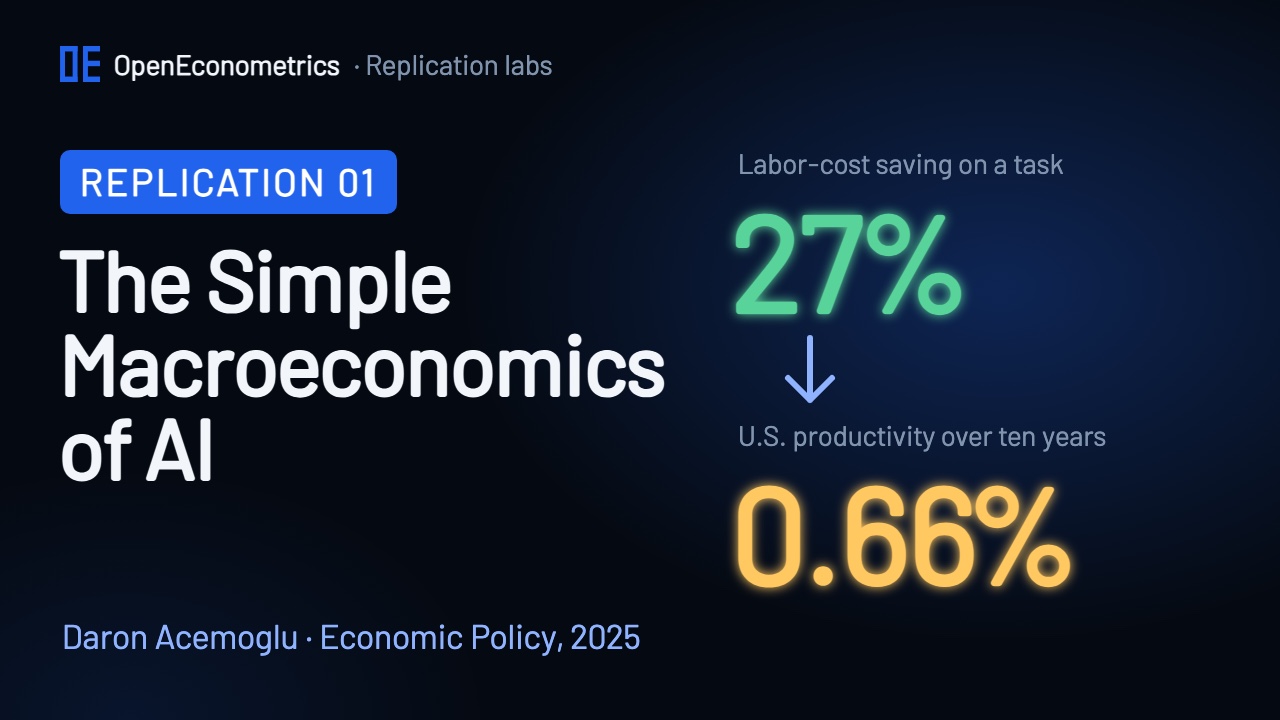
Replication 01 · Economic Policy, 2025
The Simple Macroeconomics of AI
Daron Acemoglu
Why a 27% saving on AI-assisted tasks adds up to only 0.66% more U.S. productivity in ten years: Acemoglu (2025), rebuilt in OpenEconometrics.
-
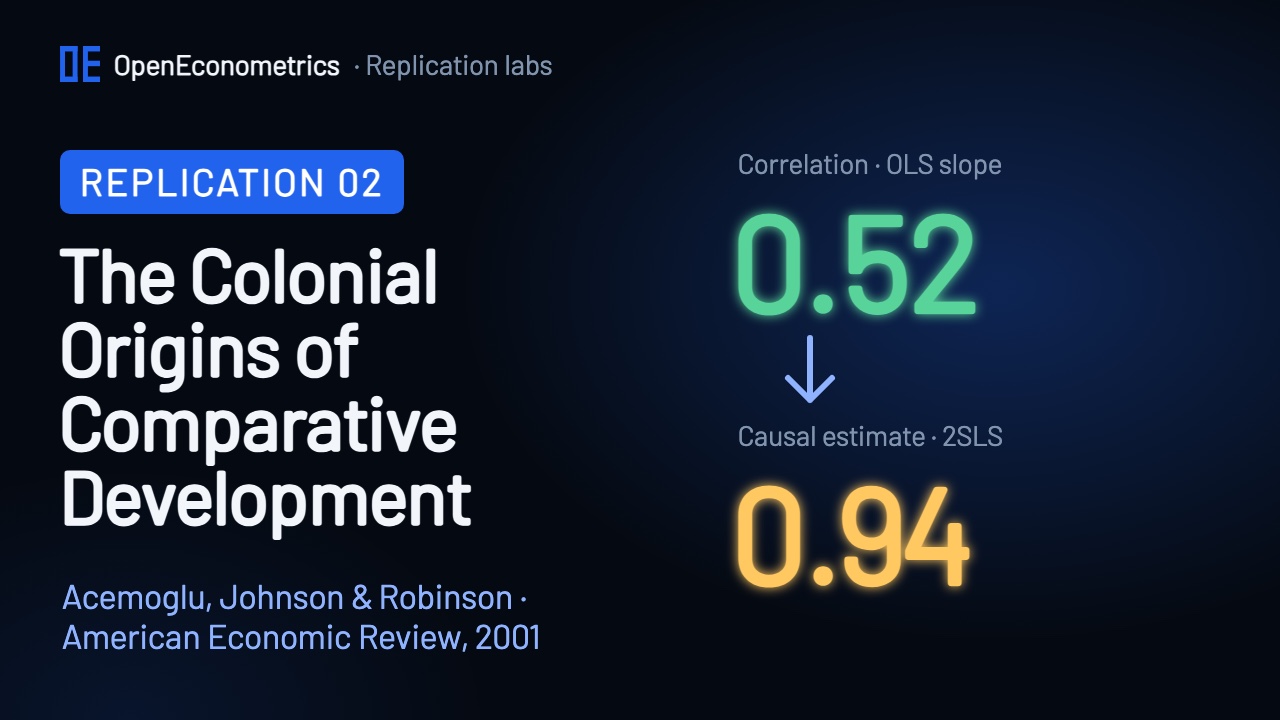
Replication 02 · American Economic Review, 2001
The Colonial Origins of Comparative Development
Daron Acemoglu, Simon Johnson, James A. Robinson
Do institutions cause prosperity? Acemoglu, Johnson and Robinson (2001) use settler mortality as an instrument; all eight tables rebuilt in OpenEconometrics.
-
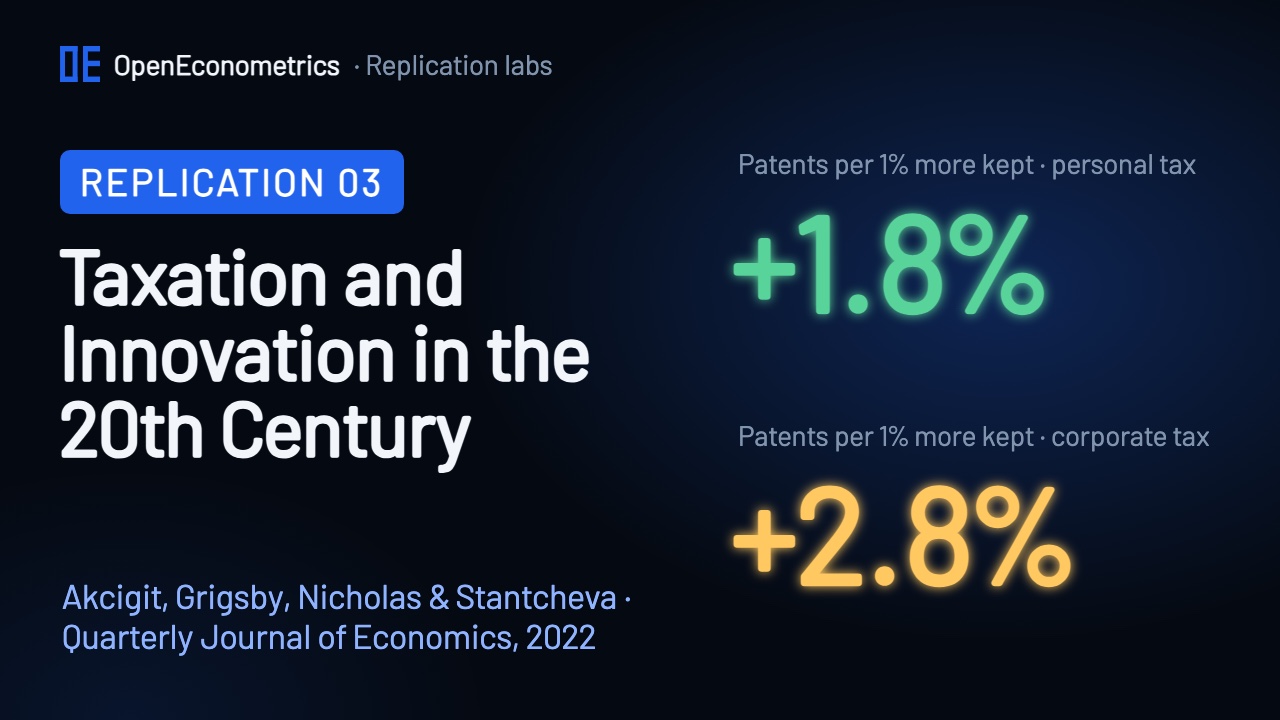
Replication 03 · Quarterly Journal of Economics, 2022
Taxation and Innovation in the Twentieth Century
Ufuk Akcigit, John Grigsby, Tom Nicholas, Stefanie Stantcheva
Do taxes change how much a state invents? The state-level results of Akcigit, Grigsby, Nicholas and Stantcheva (2022), rebuilt in OpenEconometrics.
-
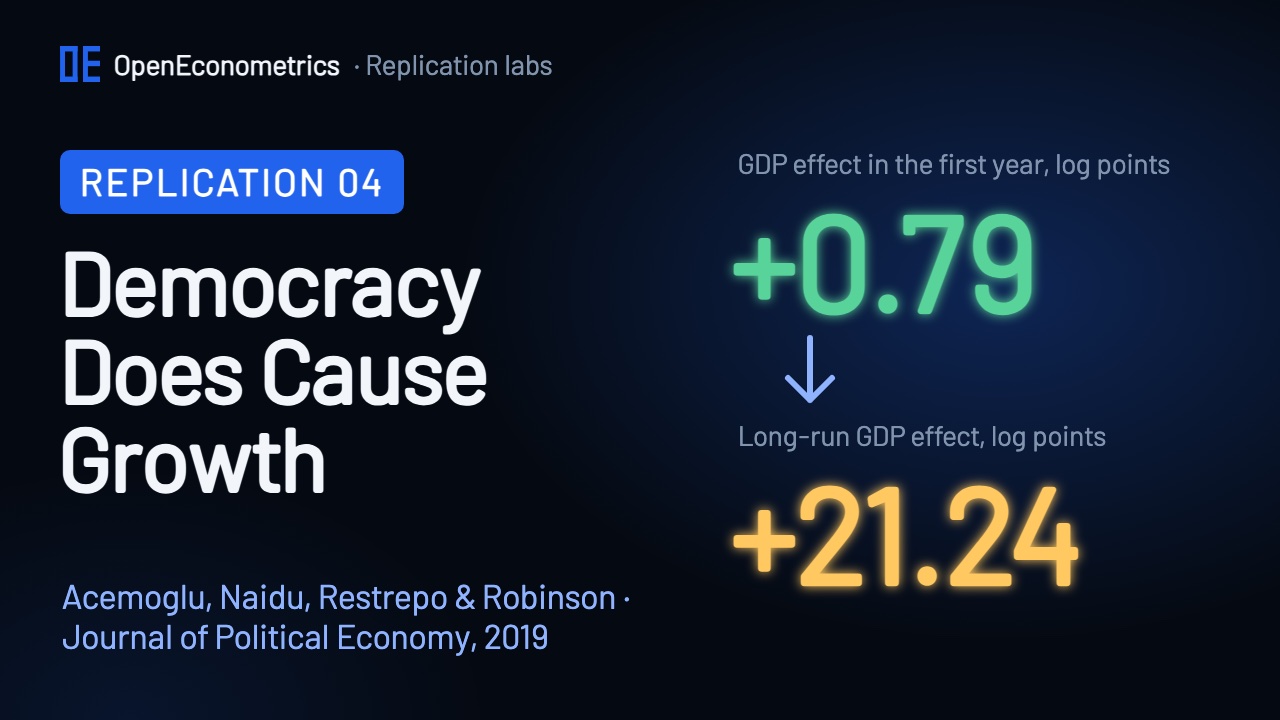
Replication 04 · Journal of Political Economy, 2019
Democracy Does Cause Growth
Daron Acemoglu, Suresh Naidu, Pascual Restrepo, James A. Robinson
Does democracy raise GDP per person? Acemoglu, Naidu, Restrepo and Robinson (2019) rebuilt in OpenEconometrics, from dynamic panel to regional waves.
-
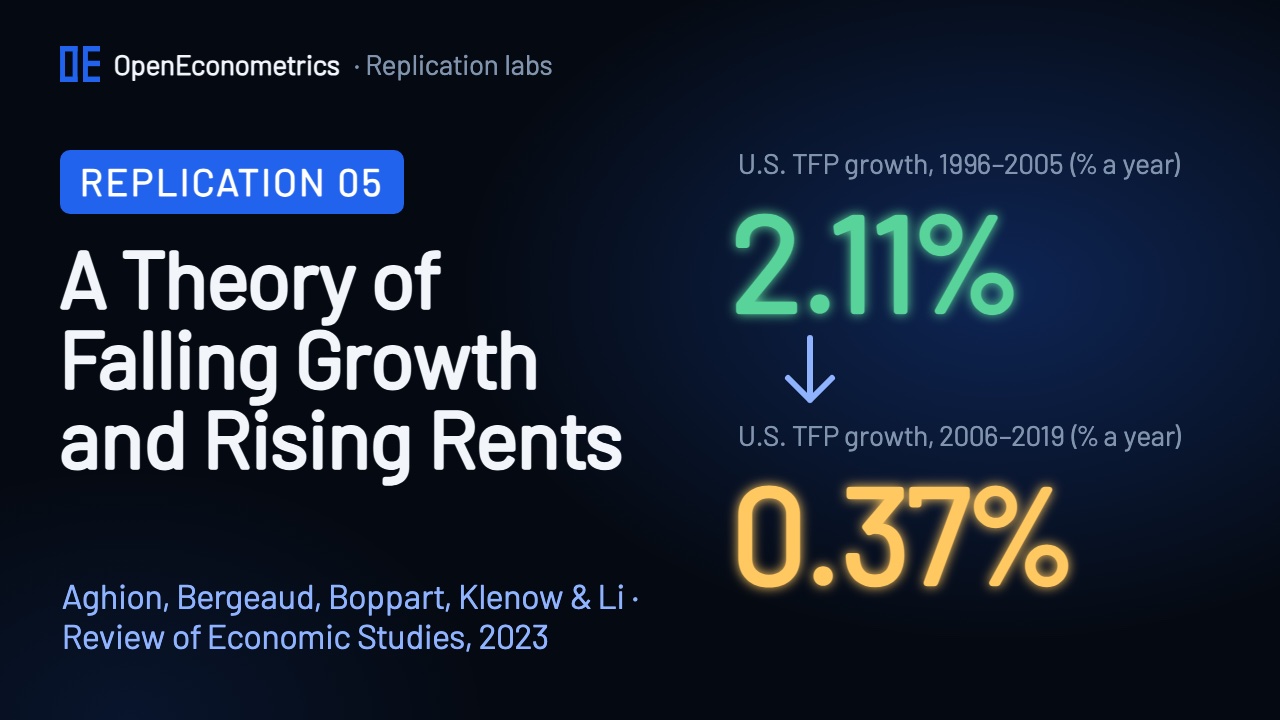
Replication 05 · Review of Economic Studies, 2023
A Theory of Falling Growth and Rising Rents
Philippe Aghion, Antonin Bergeaud, Timo Boppart, Peter J. Klenow, Huiyu Li
Why did U.S. growth speed up, then fall, as rents rose? Aghion et al. (2023): the data facts and the calibrated model rebuilt in OpenEconometrics.
-
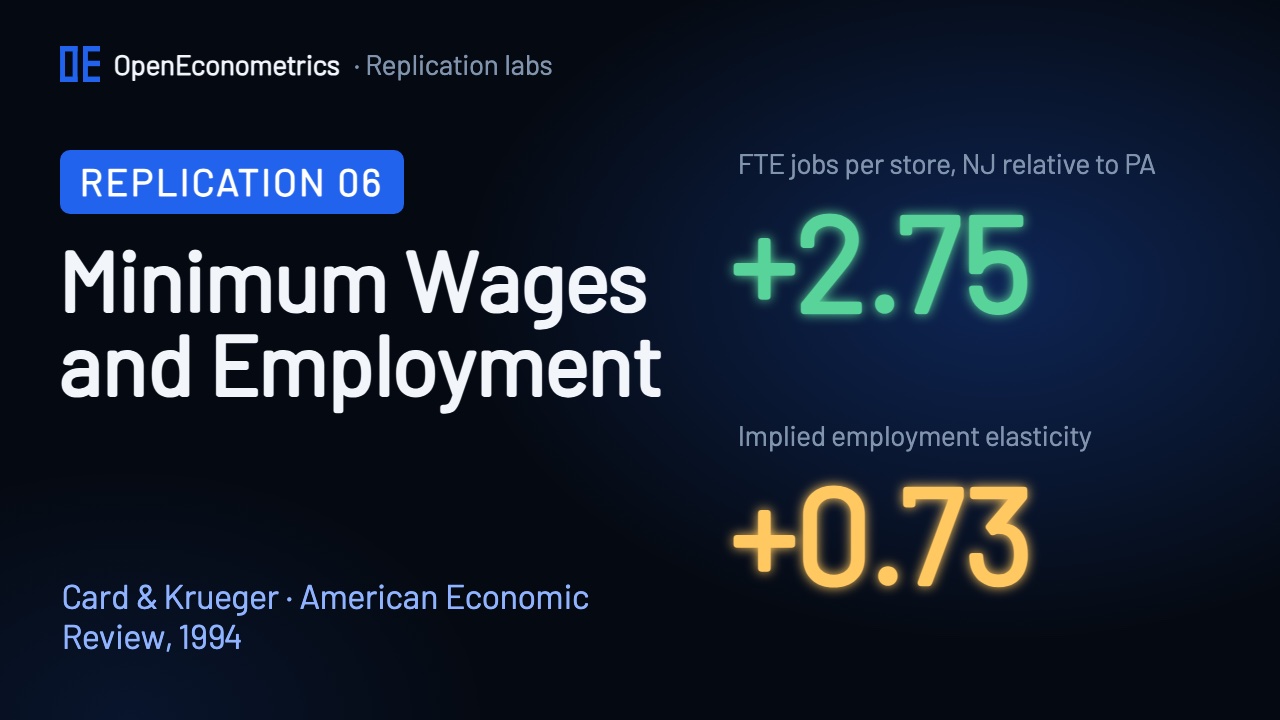
Replication 06 · American Economic Review, 1994
Minimum Wages and Employment
David Card, Alan B. Krueger
Did New Jersey's 1992 minimum-wage rise cost fast-food jobs? Card and Krueger's difference in differences, Tables 1 to 5 rebuilt in OpenEconometrics.
-
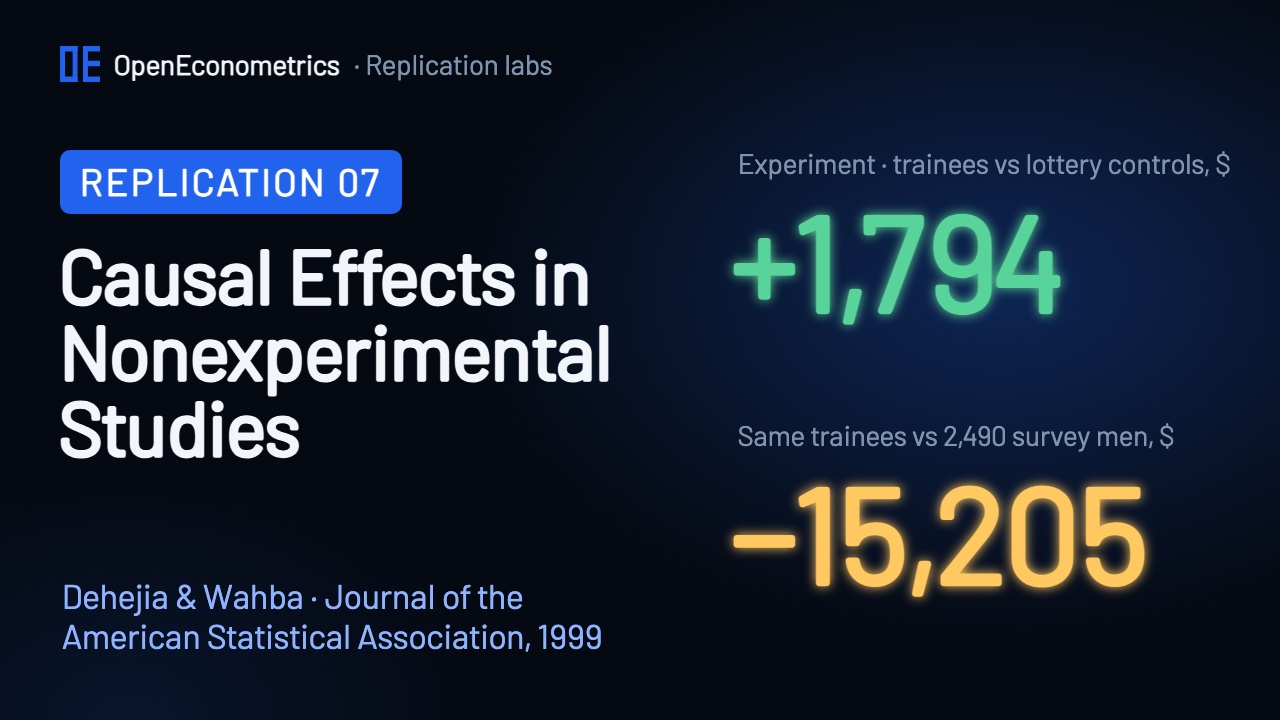
Replication 07 · Journal of the American Statistical Association, 1999
Causal Effects in Nonexperimental Studies
Rajeev H. Dehejia, Sadek Wahba
Can propensity-score matching recover a job-training experiment without the lottery? Dehejia and Wahba (1999) rebuilt, and where matching is fragile.
-
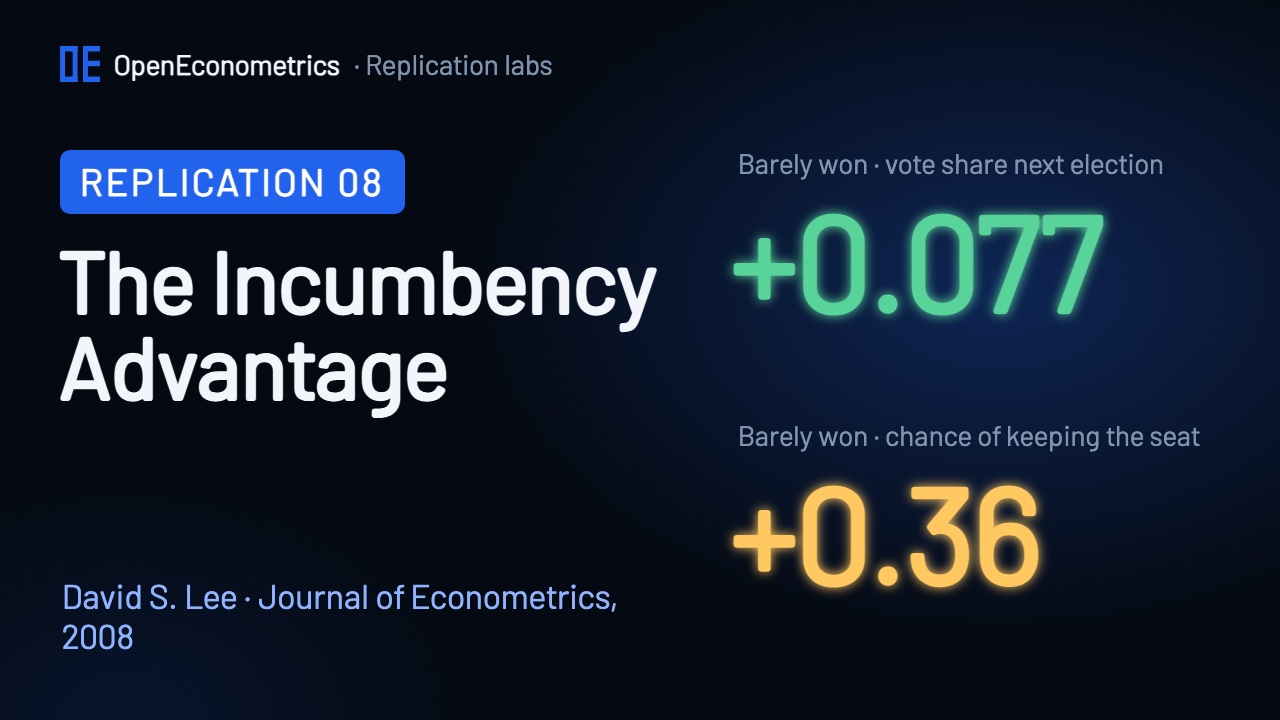
Replication 08 · Journal of Econometrics, 2008
The Incumbency Advantage in U.S. House Elections
David S. Lee
Does holding a House seat help a party win it again? Lee's (2008) close-election regression discontinuity, Tables I and II rebuilt in OpenEconometrics.
-
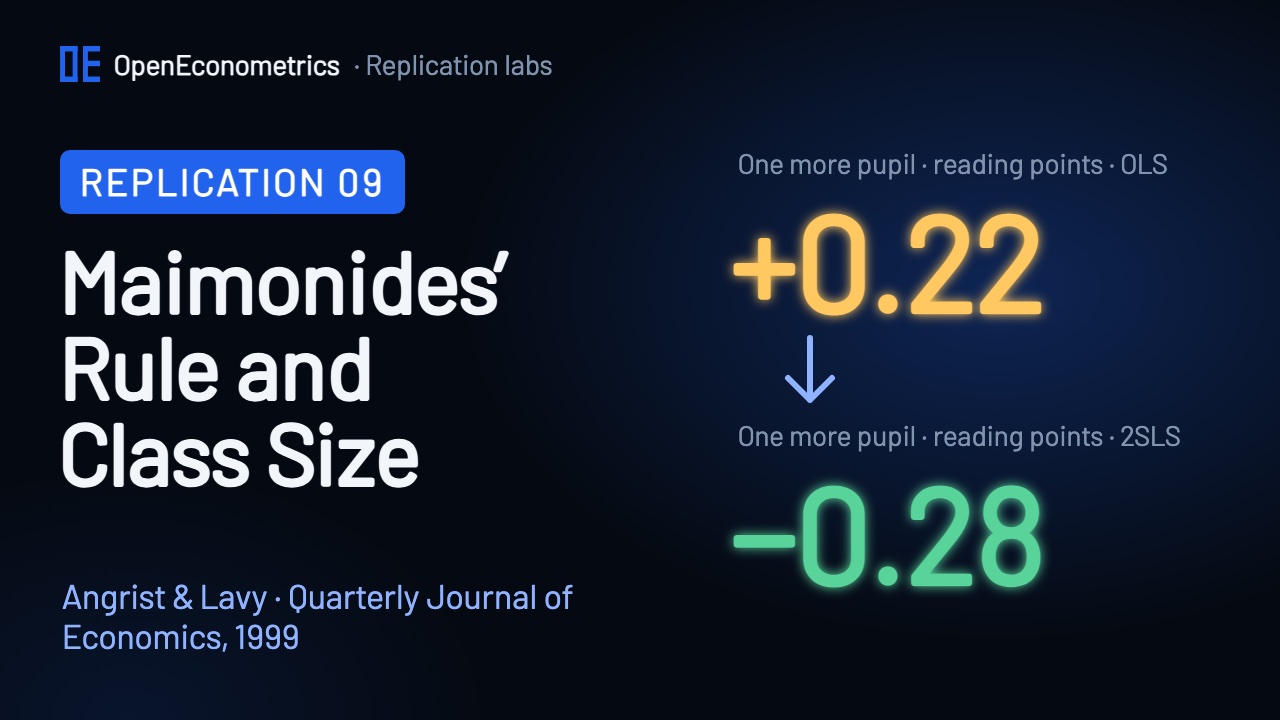
Replication 09 · Quarterly Journal of Economics, 1999
Maimonides' Rule and Class Size
Joshua D. Angrist, Victor Lavy
Do smaller classes raise test scores? Angrist and Lavy (1999) use Israel's 40-pupil class cap as an instrument; Tables I–V rebuilt in OpenEconometrics.
-
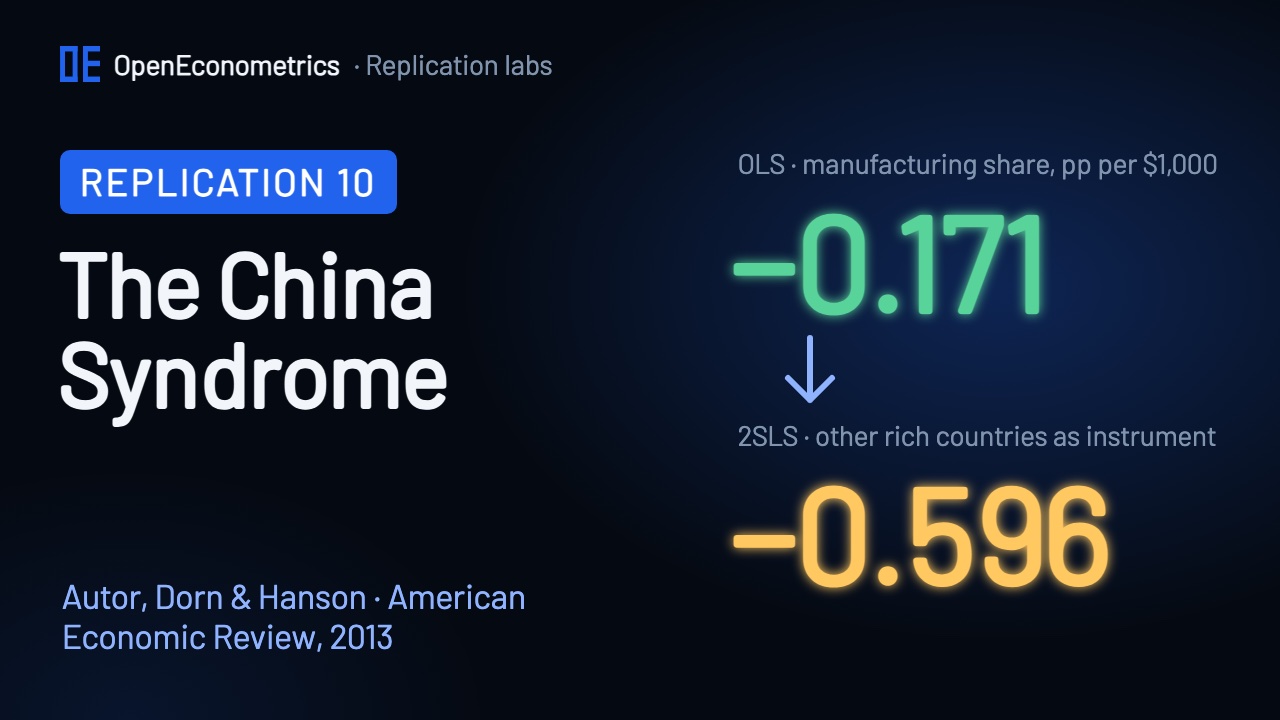
Replication 10 · American Economic Review, 2013
The China Syndrome
David H. Autor, David Dorn, Gordon H. Hanson
Did imports from China cost American factory jobs? Autor, Dorn and Hanson (2013) rebuilt in OpenEconometrics, every standard error scored two ways.
More replications are in preparation. Availability of each lab package and video lesson is listed above.
Try it on your own data
OpenEconometrics is free and open source under Apache 2.0. Install the Python library or download the desktop alpha.
pip install openecon